
If you hold a Qualifying Recognised Overseas Pension Scheme (QROPS) — most commonly in Malta, Gibraltar or the Isle of Man — you may be wondering whether it still earns its keep. Rule changes over the last few years have removed most of the advantages that QROPS once offered, particularly for anyone living in the UK or planning to return. This guide explains when transferring a QROPS back to a UK pension makes sense, how the process works, and the traps to avoid.
Transferring a QROPS to a UK-registered pension, such as a SIPP, is permitted, is not subject to the overseas transfer charge, and for many UK residents and returners now offers lower costs, simpler tax treatment and stronger consumer protection. But exit penalties, protected benefits, and your future residence plans all need to be checked first.
How many people are bringing QROPS back to the UK?
QROPS were introduced in April 2006 to help people who genuinely retire abroad take their pension with them. Over time, though, they were widely sold to people for whom the benefits were marginal, and successive rule changes have steadily eroded the original case:
- The lifetime allowance is gone. Many QROPS were set up purely to shelter funds above the lifetime allowance. The LTA charge was removed in April 2023, and the allowance was abolished from April 2024, so that rationale has disappeared.
- UK pensions became flexible. Since the pension freedoms in 2015, UK schemes have offered full flexi-access drawdown. The flexibility argument for QROPS no longer holds.
- The tax-free cash advantage has closed. Routes to higher tax-free lump sums through jurisdictions such as Malta have been progressively closed.
- The overseas transfer charge now catches most new transfers. Since 30 October 2024, transfers from UK pensions to QROPS in the EEA and Gibraltar no longer enjoy an exclusion from the 25% overseas transfer charge, unless you live in the same country as the scheme.
- QROPS enter the inheritance tax net in April 2027. Under the Finance Act 2026, unused pension funds — including QROPS held by long-term UK residents — will count as part of your estate for IHT from 6 April 2027. Keeping a pension offshore will no longer keep it outside UK IHT if you live here.
Can you transfer a QROPS back to the UK?
Yes. A transfer from a QROPS to a UK-registered pension scheme is a recognised transfer and is not itself a taxable event. There is no overseas transfer charge on money coming into the UK — the 25% charge only applies to transfers going the other way.
The usual destination is a Self-Invested Personal Pension (SIPP), which accepts transfers from most QROPS jurisdictions, offers a wide investment choice, and operates under Financial Conduct Authority (FCA) regulation with Financial Services Compensation Scheme (FSCS) protection.
A few practical points:
- The receiving scheme must be willing to accept the transfer. There are SIPP providers that accept QROPS transfers, but some ask for additional due diligence on the ceding scheme. If you remain a non-UK resident then a UK provider is more difficult as we have seen more UK platforms focusing on UK residents only.
- Funds usually transfer as cash. Investments held inside offshore bonds or non-UK fund structures often cannot be re-registered into a UK SIPP, so assets are typically sold and transferred as cash. That means time out of the market and a currency conversion if the QROPS is not held in sterling.
- Crystallised and uncrystallised funds are treated differently. If you have already taken benefits from the QROPS, the transfer needs careful handling so you don’t inadvertently restrict future tax-free cash. Specialist advice matters here.
When a transfer back to the UK makes sense
Transferring is most compelling if several of these apply to you:
- You live in the UK, or plan to return — see Returning to the UK With a QROPS for the residence-specific issues
- Your QROPS charges are high relative to a UK SIPP — typical offshore trustee fees run £750–£1,200 a year before platform, bond and fund charges, against UK SIPP administration from around £200. Our guide to QROPS fees and charges shows how to audit what you’re paying
- Your original adviser has disappeared or no longer services your account
- You want FSCS protection and FCA-regulated advice
- You want simpler estate administration ahead of the April 2027 IHT change
When keeping the QROPS may be better
A transfer back is not automatic best advice. Staying put can make sense if:
- You will retire abroad permanently. A QROPS in your country of residence can pay benefits in local currency, and a future transfer overseas from a UK scheme could trigger the 25% overseas transfer charge.
- Your scheme has protected or guaranteed benefits that would be lost on transfer.
- Exit penalties are punitive. Some legacy structures, particularly those wrapped in offshore bonds with long surrender periods, impose heavy early-exit charges. Sometimes, waiting out a surrender period before transferring is the better sequence.
- Non-UK tax applies. Your current country of residence may tax the transfer or treat it unfavourably under local rules or a double taxation agreement.
Sometimes the right answer is a middle path: keeping the QROPS but appointing a new, properly regulated adviser and moving to cleaner, cheaper investments inside it. We cover this in How to Change Your QROPS Adviser.
Understanding the parties in a QROPS
Frequently, people do not know the structured multi-party ecosystem their pension sits within. So its important to outline the various parties. Each of these likely charges a flat or variable fee, and this should be disclosed to you. Some situations where commissions are paid are not always presented clearly adn centre. Presenrting all the fees is now commonplace in high regulated countries like the UK.
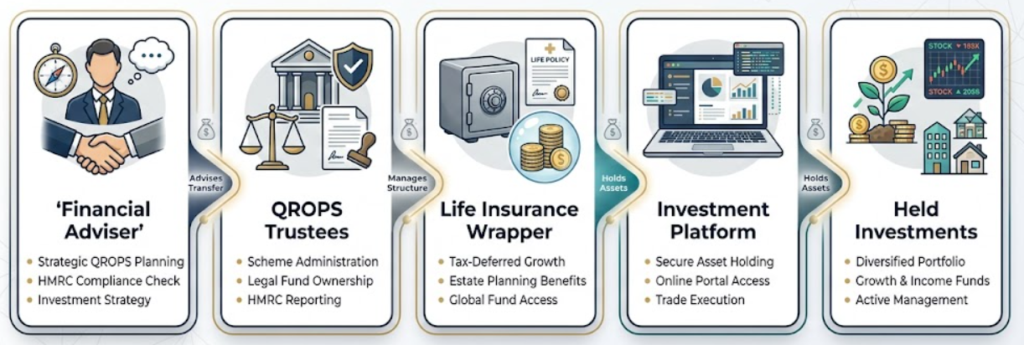
To give you a clear idea of what this looks like, think of your QROPS as a secure house where your money lives. Each party plays a specific role in building, managing, or protecting that house.
Financial Adviser
- The Role: The Architect.
- What they do: They assess your situation, make sure you won’t get hit by HMRC’s 25% Overseas Transfer Charge, and recommend the setup. Because QROPS are complex, most trustees won’t even accept your business unless a regulated adviser submits it.
- Key watch-out: Ensure they are regulated in both the jurisdiction you live in and the jurisdiction where the QROPS is based.
The Trustee / Scheme Administrator
- The Role: The Legal Landlord.
- What they do: Once your UK pension transfers out, the Trustee legally takes ownership of the funds to hold them on your behalf. They handle the heavy administration, ensure the scheme maintains its “QROPS status” with HMRC, report withdrawals, and make sure everything complies with local pension laws (often in jurisdictions like Malta or Gibraltar).
The Life Insurance Wrapper (Offshore Bond)
- The Role: The Tax Shield / Outer Walls.
- What they do: This is an investment structure (often issued by life insurance companies based in the Isle of Man, Dublin, or Guernsey) that sits inside the pension trust. It acts as a tax-deferred wrapper, allowing investments to grow free of local capital gains or income taxes.
- Key watch-out: Historically, these wrappers were notorious for heavy, multi-year exit fees and hidden commissions. Many modern setups skip this layer entirely if the platform handles the tax structure cleanly on its own.
The Investment Platform (The Custodian)
- The Role: The Digital Vault.
- What they do: If the life wrapper is the wall, the platform is the actual shelf where your money sits. This is an online investment platform (an offshore wrap platform) where your cash is converted into currencies (like Euros, US Dollars, or Sterling) and where buy/sell orders are executed. It gives you and your adviser an online portal to see what the portfolio is worth.
Investments Holdings
- The Role: The Engines of Growth.
- What they do: This is what actually makes your money grow. Within the platform, your money is used to buy retail investments. This typically includes:
- Mutual funds or ETFs (Exchange Traded Funds)
- Discretionary Fund Managers (DFMs) who manage a portfolio model for you
- Cash deposits in different currencies
- Key watch-out: Avoid “unregulated collective investment schemes” (UCIS) or exotic investments (like overseas property syndicates) which are high-risk and frequently targeted by scammers in the offshore space.
QROPS Capital Flow Mechanics
Click any layer along the operational pipeline to map out responsibilities, compliance requirements, and potential cost leakages.
The Financial Adviser
Your adviser coordinates the transfer strategy. They must cross-reference your residency timeline against HMRC’s statutory requirements to ensure the transfer does not trigger an immediate 25% Overseas Transfer Charge.
Regulatory Body
FCA (UK) / Local Regional Regulator
Primary Risk
Inappropriate scheme selection or hidden commissions
The QROPS Trustee
The Trustee assumes formal, legal ownership of your pension fund. Operating out of jurisdictions like Malta or Gibraltar, they are the entities that register the scheme directly with HMRC and guarantee continuous legislative compliance.
Regulatory Body
MFSA (Malta) / GFSC (Gibraltar)
Primary Risk
Loss of QROPS status if rules change or reporting fails
The Life Insurance Wrapper
An offshore life assurance bond that acts as an umbrella inside the trust structure. It prevents portfolio adjustments from creating immediate tax footprints across different international tax offices.
Typical Structure
Guernsey / Isle of Man / Dublin Insurance Bond
Primary Risk
Long lock-in periods and heavy early exit penalties
The Investment Platform
The software platform and safe custodian where your money is converted into major international currencies (GBP, EUR, USD). This terminal lets you and your manager execute liquid trades across globally recognized markets.
Core Function
Currency clearing, trade execution, institutional custody
Primary Risk
Compounding platform administration fees and high trading costs
The Held Investments
The real engines driving capital growth. Your money is split across chosen global mutual funds, liquid Exchange Traded Funds (ETFs), or directly managed by specialized Discretionary Fund Managers (DFMs).
Asset Types
Institutional Mutual Funds, Fixed Income, Indexes
Primary Risk
Illiquid, unregulated toxic funds pushed by non-regulated brokers
The transfer process, step by step
- Gather scheme information. Request a current valuation, fee schedule, exit penalty statement and confirmation of any protected benefits from your QROPS trustee.
- Take regulated advice. A UK-authorised adviser can compare your QROPS against a UK alternative on costs, tax, benefits and your residence plans. (This is also the stage where poor-value schemes tend to be exposed.)
- Choose the receiving scheme. Usually a SIPP; the right platform depends on fund size, investment approach and whether you are UK resident.
- Instruct the transfer. The SIPP provider and QROPS trustee correspond directly; you’ll complete discharge forms and identity checks.
- Assets are sold and cash is transferred. Expect a currency conversion if the scheme is not sterling-denominated.
- Reinvest inside the SIPP according to your plan.
A straightforward QROPS-to-SIPP transfer typically completes in around six to eight weeks, though offshore trustees can be slower, especially where an offshore bond has to be surrendered first.
Costs and tax to check before you sign
- Exit and surrender penalties from the QROPS trustee and any underlying insurance bond
- Adviser charges for the transfer advice — insist on a fee quoted in pounds, not a percentage buried in a product
- Currency conversion costs on the transfer
- Local tax in your country of residence, if you live outside the UK
- Loss of any higher tax-free cash entitlement already secured under the QROPS rules — take advice before assuming this is preserved or lost
How Edale can help
Edale is an FCA-regulated, fee-based UK adviser (FCA reference 812332) with a specialism in cross-border and expatriate financial planning. We regularly review QROPS for people who have returned to the UK, are planning to, or simply suspect their offshore arrangement is costing more than it should. A review will tell you plainly whether transferring, restructuring or staying put is in your interest — including when the answer is to do nothing. If you’d like a second opinion on your QROPS, get in touch.